

Wars obey mathematical laws that were written down decades ago, some of them more than a century old. These laws explain what is happening today in Ukraine, the Red Sea, and the skies over the Middle East better than any news bulletin. This article walks through four simple equations that require no background in mathematics, each paired with the battlefield evidence that bears it out.
On September 8, a small item appeared in the specialist American defense press and went largely unnoticed. The U.S. Air Force, the richest air force in history, had seen its combat fleet shrink to 1,098 fighters, below the 1,145-aircraft minimum set by U.S. law itself, and projections show that number continuing to fall through 2030.
Pause on that for a moment. A country that spends more on defense than the next ten nations combined cannot field the minimum number of fighters its own lawmakers wrote into statute. The cause is not mismanagement or some official’s blunder. It is the outcome of an equation an American engineer wrote in 1983, one that described with uncanny precision what would happen forty years later.
War, like any large-scale human enterprise, is governed by arithmetic, and those who ignore it lose while believing they are advancing. Here I will lay out just four equations, along with the evidence from today’s battlefields that proves each one.
Equation One: Lanchester, and Why Numbers Are Worth More Than Quality
In 1916, as Europe burned in the First World War, the British engineer Frederick Lanchester devised a set of equations describing what happens when two armies exchange aimed fire at long range. A year earlier, the Russian Mikhail Osipov had arrived at the same result.
Lanchester’s Square Law boils down to a single line:
Combat power = (numbers × numbers) × effectiveness of each unit
Notice the asymmetry. Numbers enter the equation squared, while quality enters only linearly. Double the size of your force and your combat power quadruples; double the quality of each unit and it merely doubles.
Take an army of 100 units, each with an effectiveness of 1: its combat power is 100 × 100 × 1 = 10,000. Now take an army of 50 units, each twice as good: its combat power is 50 × 50 × 2 = 5,000.
The larger force ends up with twice the combat power, even though its opponent fields weapons that are twice as good, piece for piece. To make up the difference, the side with fifty units doesn’t need to be twice as good. It needs to be four times as good.
This equation explains precisely why the world’s militaries have all shifted toward a doctrine of mass in recent years, and why the U.S. military itself, which still builds its combat simulations on modified versions of Lanchester’s equations, is rethinking its faith in the single exquisite platform. Researchers have recently developed an extended Lanchester model for drone warfare, and their conclusion deserves to be posted on the door of every defense ministry: in drone-saturated warfare, the outcome is decided by production depth, meaning how fast expendable systems can be manufactured, ahead of tactical skill and even ahead of the cost differential.
Equation Two: Augustine, and Why Militaries Shrink While Spending More
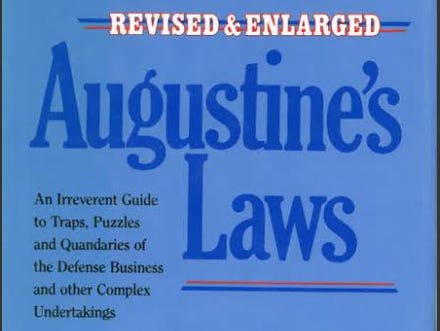
In 1983, Norman Augustine, an engineer and senior U.S. defense official, published a set of tongue-in-cheek laws about the arms industry. The most famous is Law No. 16, which holds that in the year 2054 the entire U.S. defense budget will buy just one fighter aircraft, to be shared by the Air Force and the Navy for three and a half days a week each, with the Marine Corps getting it on the extra day of leap years.
The joke is wrapped around a brutal equation. The cost of a single fighter grows exponentially, doubling every fixed number of years, while the defense budget grows linearly, rising by a limited amount each year. When a curve that keeps doubling races a line that creeps upward, the outcome is a foregone conclusion. The first will eventually overtake the second, and long before it does, the number of aircraft you can afford will already have collapsed.
Don’t read this law as an economist’s joke. It explains exactly why the richest air force in history has fallen below its legally mandated minimum of fighters, why entire countries today buy twenty-four fighters where thirty years ago they bought a hundred, and why losing a single aircraft in combat becomes a strategic event that shakes a nation.
I call this phenomenon voluntary disarmament, because here the military disarms itself, with no treaty and no defeat, all while believing it is modernizing.
Equation Three: Wright, and Why Your Weapons Cost So Much
In 1936, while studying aircraft factories, the American engineer Theodore Wright noticed a consistent pattern and formulated it into the law that bears his name:
Every doubling of cumulative production cuts unit cost by a fixed percentage, roughly 20% in most industries.
In other words, if you build a hundred units and then a second hundred, the unit cost falls by a fifth. Reach four hundred, and it falls by another fifth. The reason is simple: workers master their tasks, the factory reorganizes its lines, and suppliers invest in better tooling because they are confident the demand will last.
This principle explains exactly why your weapons stay expensive even when you build them yourself. The F-35’s own price fell from more than $200 million in its early production lots to around $80 million as orders, and with them production, accumulated. By contrast, when the THAAD interceptor line turns out 11 missiles in a fiscal year, it is effectively not moving down the learning curve at all, which is why each missile stays at $12.7 million no matter how much time passes.
Now look at the flip side of the same law. A Ukrainian-made 155 mm artillery shell costs around €2,500, while a French or Norwegian one runs as high as €8,000. The difference isn’t in the metal or the chemistry. It’s in how many shells each production line has turned out.
This is why the Pentagon has started signing seven-year contracts, and why Poland signed a framework agreement for roughly 1,400 infantry fighting vehicles in one go. A country that guarantees a factory long-term demand buys the same weapon for less; a country that buys in small, scattered batches pays the price for ignoring the learning curve.
Equation Four: The Cost-Exchange Ratio
This equation is at once the simplest and the most dangerous.
Cost-exchange ratio = what you spend to defend ÷ what your adversary spends to attack
If the ratio is greater than one, you lose economically in every engagement, even the ones you win militarily. If it’s less than one, you bleed your opponent every time they attack you.
Apply the equation to the Red Sea. An SM-2 missile costs $2.1 million, while the drones it intercepts start at $2,000 and in most cases cost no more than $20,000. That puts the ratio somewhere between 100 to 1 and 1,000 to 1. And on that basis, the U.S. Navy fired more than two hundred interceptors in fifteen months.
Now apply it to the newer solutions. The laser-guided APKWS rocket costs $35,000, bringing the ratio down to less than two to one. Germany’s Gepard anti-aircraft gun brings drones down with rounds costing between $300 and $1,000, which flips the ratio entirely to below one. In other words, the defender is now the one bleeding the attacker.
This simple arithmetic explains exactly why the U.S. Navy described its Red Sea equation as unsustainable, and why militaries everywhere are now racing toward lasers, guided artillery, and interceptor drones. Modern warfare doesn’t ask who shot down the target. It asks what it cost to do so.
Putting the Four Equations Together
Place the four laws side by side and you’ll find that they all point in the same direction. Lanchester says numbers multiply your strength faster than quality does. Augustine says the pursuit of quality devours numbers. Wright says volume is what drives down the unit price. And the cost-exchange ratio says that whoever fights with expensive tools against cheap ones loses, even while winning every engagement.
The conclusion that ties them together is what I call easy mass: a force that performs well enough, exists in abundance, is financially sustainable, and can be produced at home. Put simply, a weapon that is good enough and plentiful beats one that is perfect and scarce.
Does This Mean Quality Is Dead?
No. And this is precisely where many who read these equations superficially go wrong, walking away with the slogan that cheaper is always better.
Go back to Lanchester’s equation and look at its hidden assumption. It presumes that the two armies exchange fire in full, with every unit able to see its opponent and shoot at it. But what if you see your enemy before he sees you, and destroy part of his force before he fires a single shot?
Then you have changed the value of the numbers themselves before the battle even begins, and that is the most valuable thing technology can buy today.
Put differently, the real value of technological superiority in our era has shifted from the platform to reconnaissance, communications, battle management, electronic warfare, and artificial intelligence, because these are the tools that tip the numbers in your favor. Raising the price of a single aircraft by fifty percent in exchange for a marginal gain in performance, on the other hand, is walking willingly into Augustine’s equation.
What Does This Mean for Middle Powers?
Three practical conclusions follow directly from these equations. First, every procurement decision is a decision made inside an equation that squares numbers. A country that buys twenty-four exquisite platforms goes into battle with a force of 24, however dazzling those platforms may look at a military parade.
Second, a budget that multiplies cumulative production is worth more than one that buys the latest model. The first buys you a lower price and the ability to replace losses; the second buys you an image.
Third, you must calculate the cost-exchange ratio of any defense system before you buy it. If the ratio works against you, you are buying a deferred economic defeat, no matter how high its advertised hit rate.
For all of these reasons, I will close with this: the laws of war do not punish those who have less advanced weapons. They punish those who build their forces without understanding the equations that will govern how those forces are used.