

Ask any national security expert to map the chokepoints in the defense industrial base, and the top of the pyramid will almost always look the same: advanced semiconductors, lithography machines, jet engines.
That map makes perfect sense.
It is also wrong.
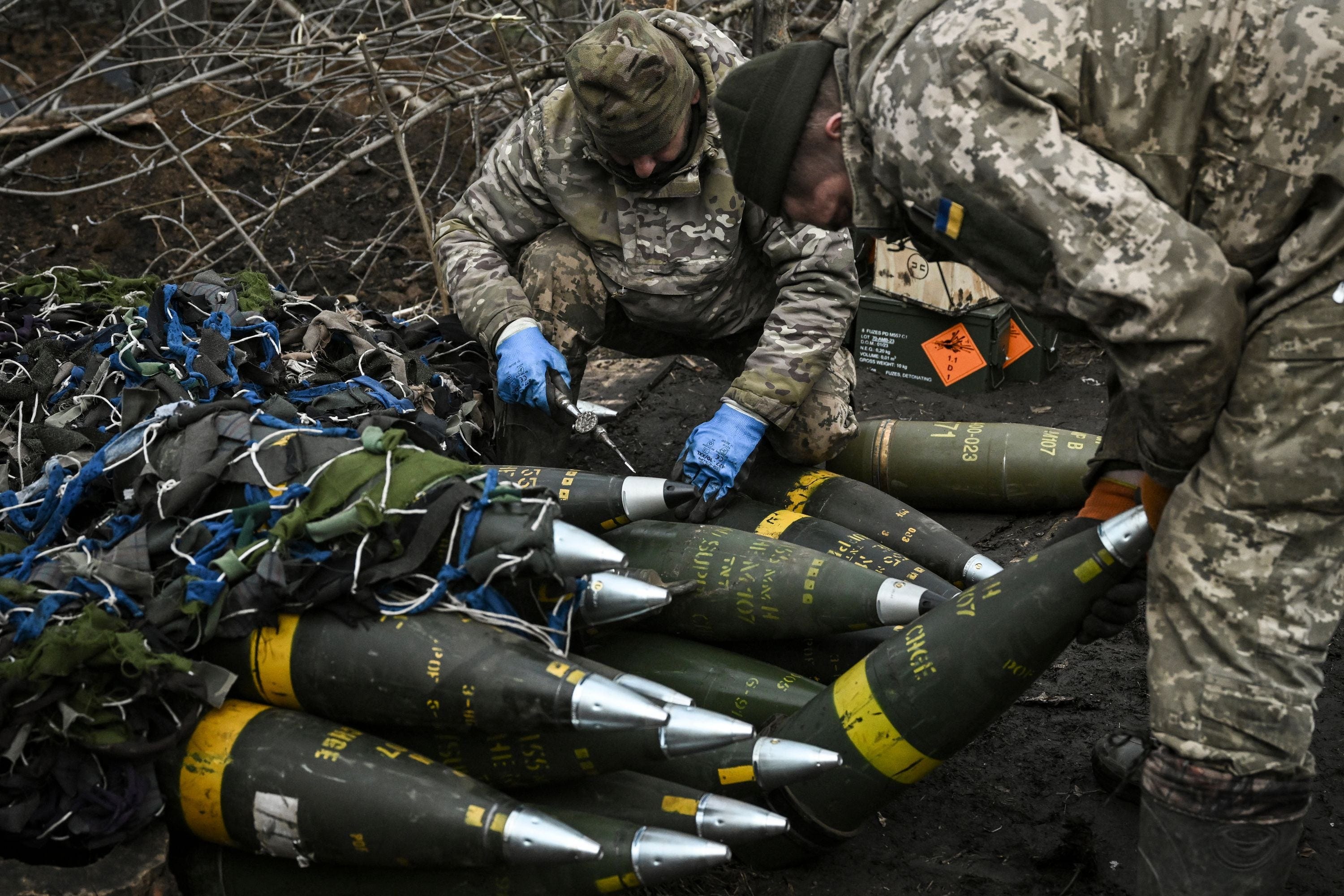
Because the war in Ukraine exposed something that was largely missing from that picture: even the world’s most advanced militaries do not necessarily grind to a halt for lack of chips. Sometimes they grind to a halt for lack of gunpowder.
Consider the 155mm artillery shell. The underlying technology dates back to the First World War. By modern standards, it is almost archaic. Yet Russia produces several times more of them than the Western countries combined. Europe keeps announcing higher production targets, then pushing the deadlines back. The United States, while trying to expand ammunition output, discovered that it had not produced TNT domestically since the 1980s. Its missile production base depends on just two suppliers for solid rocket motors. And when Washington tried to restart Javelin and Stinger production, manufacturers discovered that some components designed in the 1990s had simply disappeared from the market.
So the obvious question is this:
How can countries capable of building the F-35 struggle to manufacture a material whose chemistry dates back to the nineteenth century?
The answer is not technology.
It is economics.
More specifically, it is profit margin.
In peacetime, the economically rational outcome is that the cheapest, lowest-margin parts of a supply chain gradually migrate toward whoever can produce them at the lowest cost. That is market efficiency working almost exactly as the textbooks say it should.
Propellants, castings, forgings, gun barrels and similar components are low-margin businesses. Production is slow, capital-intensive and unglamorous. Large firms have little incentive to stay in them. So these capabilities quietly leak across borders—not necessarily because of any grand political decision, but year after year, almost invisibly.
Meanwhile, the entire national-security apparatus—investment-screening committees, export-control regimes, strategic reviews—has spent decades staring at the top of the pyramid: Who is buying the laser company? Who has access to advanced lithography? Who is acquiring sensitive electronics?
Nobody was watching the cotton.
Until Western governments discovered that nitrocellulose, one of the fundamental ingredients in propellants and ammunition, depends on processed cotton fibers whose global supply is heavily concentrated in China.
And that leads to a much more important rule:
Strategic dependence is not necessarily concentrated in the most technologically advanced parts of the industrial base.
It is often concentrated where profit margins are lowest.
Markets rank components by profitability.
War ranks them by availability.
And those two rankings can be almost the reverse of one another.
What sits at the bottom of the market’s priority list can sit at the very top of the military’s wartime priority list.
The deeper problem is that these two kinds of industrial gaps are not repaired in the same way, or on the same timetable.
A shortage at the top of the pyramid often begins correcting itself because solving it is profitable. Look at the amount of capital that rushed into semiconductors the moment chips became a strategic priority: subsidies, new fabs, private investors, entire investment ecosystems competing to participate.
But shortages at the bottom of the pyramid do not respond the same way, even during wartime.
A TNT plant is a thirty-year investment in a product whose demand may collapse the moment peace returns. Very few corporate boards or investment funds find that proposition attractive. Capital naturally runs toward the profitable shortage, not necessarily toward the strategically urgent one.
That means dependence at the top of the pyramid can be temporary by nature.
Dependence at the bottom can become chronic by nature.
Yet most of the world worries obsessively about the first while assuming the second will somehow fix itself—or that the state will eventually step in and solve it. And that is where the financing problem begins, something I discussed before in my article on who actually pays for war.
Here is one detail that captures the entire argument.
The first new TNT plant being built in the United States in more than forty years—who is building it?
A Turkish company.
The superpower that manufactures perhaps the most sophisticated combat aircraft ever built is effectively outsourcing part of the bottom of its industrial pyramid to a country that never completely abandoned the boring, low-margin layers of defense production.
Gunpowder has no prestige.
But when war comes, everyone eventually ends up waiting at the door of whoever can still make TNT.
None of this is historically new. The striking thing is how often states forget it.
In 1943, the Allies sacrificed hundreds of bombers and aircrews over Schweinfurt. What were they trying to destroy?
Not aircraft factories.
Not advanced research laboratories.
Ball-bearing plants.
Tiny metal components worth almost nothing individually.
The strategic logic was understood eighty years ago: a war machine can be stopped by its cheapest components, not necessarily its most expensive ones.
And what does any of this have to do with us in the Middle East?
Everything.
Because this is not merely a flaw in the Western defense industrial system. It is a flaw built into localization programs from the Gulf to Cairo—and, to some extent, even Ankara.
Localization strategies tend to rank priorities by prestige.
We want to manufacture the impressive platform. We want the assembly line. We want the inauguration ceremony, the ribbon cutting, the photograph of the final product.
War ranks priorities differently.
And so the same pattern keeps appearing: states localize what looks good in a photograph and import what actually wins the war.
How do you identify the difference?
Take the complete bill of materials for any major weapons system and rank its components in ascending order by the supplier’s profit margin.
Look closely at the first ten items.
That list is probably a better map of your real strategic vulnerabilities than most national-security reports.
And I would bet you will not find lasers, AI processors or cutting-edge semiconductors at the top of it.
You are more likely to find propellant, castings, processed cotton, gun barrels and ball bearings.
Which brings me to a rule I came up with while writing this:
Collapse begins at the bottom of the pyramid, not the top.
The real chokepoint in a weapons system was never necessarily its most expensive component.
More often than not, it is the cheapest one.