

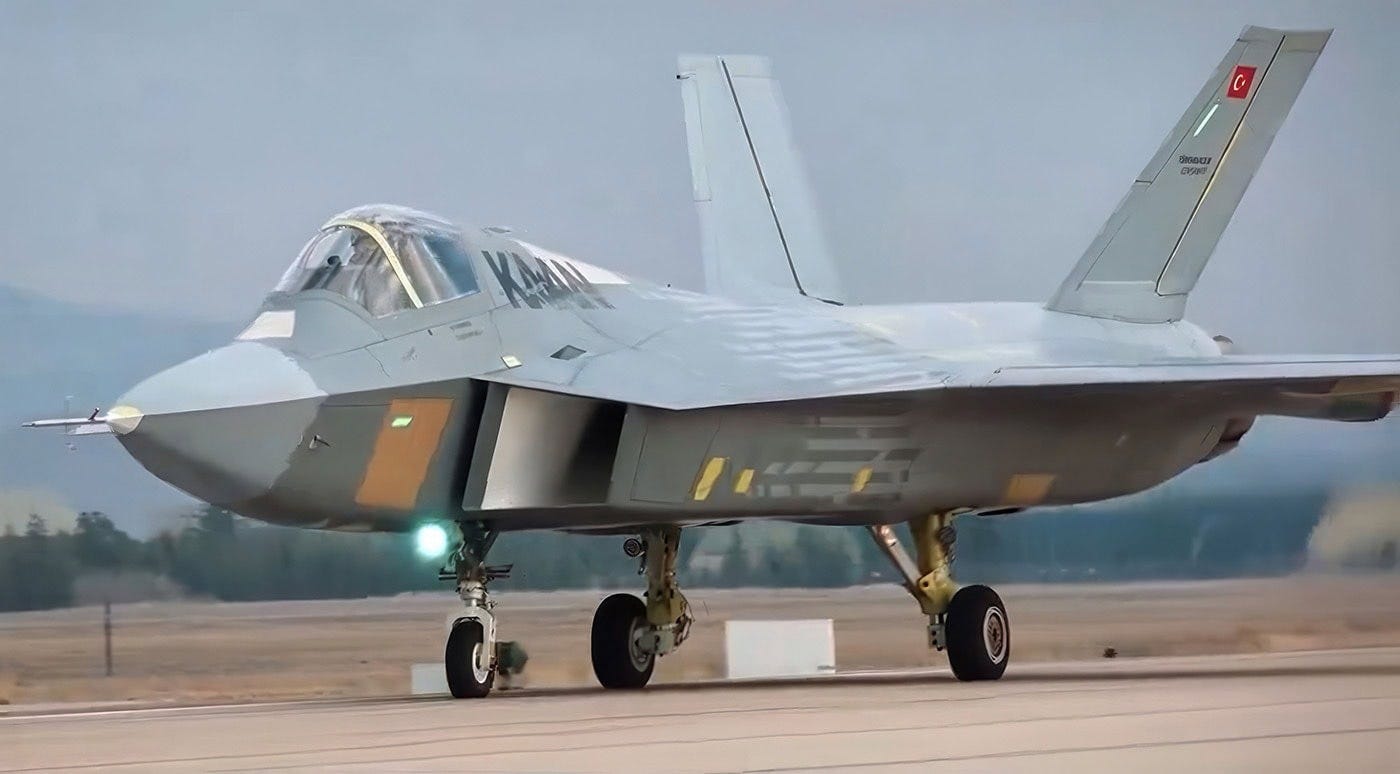
Türkiye spent decades facing embargo after embargo, all designed to slow the development of its defence industry. So why, when it finally gained technologies of its own, did it open the door to international partnerships?
At first glance, this might look like a contradiction within the Turkish defence industry. But the reality is quite different.
Türkiye spent forty years fighting for access to technology. Every component, every system and every piece of knowledge had to be wrestled from someone’s hands—after negotiations, political pressure, embargoes and restrictive conditions.
Yet the moment Türkiye began developing its own technologies, the picture changed. A factory is being built in Ukraine. Indonesia is joining the KAAN fighter programme as a partner. Gulf countries and Egypt are discussing joint production and technology transfer.
So why?
The easy answer is that these are negotiating concessions—extra incentives added to get a deal across the line.
But that answer is wrong.
The real explanation is that, beyond a certain level of complexity, a weapon stops being a product and becomes an entire system: a relationship that can last for decades.
What does that mean?
A rifle is a product. You sell it, receive the payment, and the transaction is over. Up to a certain level of complexity, a drone is still a product too.
A fighter jet, however, is not a product.
A fighter jet is a relationship lasting at least forty years: spare parts, pilot training, software updates, weapons integration, data links, certification, maintenance, development and continuous modernisation.
This is why countries do not simply buy fighter jets. Every major fighter aircraft in the world has an entire ecosystem built around it. The F-35, for example, is not merely an aircraft. It is a club—a system of countries connected to one another through the programme.
That is why I do not believe KAAN’s real competitor is the F-35 itself. Its real competitor is the group of countries surrounding the F-35, along with the interests, factories, supply chains and political relationships that have been built around the programme.
Developing a fighter aircraft can cost tens of billions of dollars. And the unit cost of each aircraft will never fall to a reasonable level unless hundreds are produced. Orders from the Turkish Air Force alone could never be enough to make this basic and well-known economic equation work.
The United States is perhaps the only country capable of financing a fighter programme of this scale on its own.
And even the United States does not do that.
Countries larger and wealthier than Türkiye—such as Britain, Italy and Japan—had to come together under the GCAP programme. France, Germany and Spain joined forces in the FCAS programme.
This is where we can begin to understand Türkiye’s apparent generosity when it comes to technology transfer.
Türkiye is effectively offering technology in exchange for financing and for bringing other countries into the KAAN club. This is the same logic behind almost every international fighter programme.
A country entering the market late and seeking membership in an established club usually has to provide funding. Meanwhile, a country trying to establish a new club must offer those partners technology in return.
There is a subtle difference here.
The United States tells you: pay to enter the club.
Türkiye tells you: join the club, and I will give you a share of the technology and production—and you can pay in instalments.
That difference reflects the industrial depth of each country, as well as its diplomatic capabilities. I will return to that point shortly.
Türkiye’s willingness to transfer technology is therefore not an act of goodwill, nor is it driven by some desire to spread scientific knowledge among nations.
It is a necessity and a matter of mutual interest.
The programme needs to attract members before the aircraft itself is even complete, because without those members, the project has no viable economic foundation in the first place.
Indonesia’s entry into the KAAN programme, alongside the discussions in 2025 about an order for 48 aircraft, was effectively the founding announcement of the club I am describing.
South Korea followed the same approach with the KF-21 programme. Indonesia was brought into the project from the very beginning. Payment problems later emerged, and Indonesia’s share in the programme was reduced, but the underlying logic was the same.
The problem is that this strategy comes at a price.
The partner you attract today by offering technology may become your competitor tomorrow. A country you help establish a production line today may develop its own product ten years from now and compete against you in the very same markets.
Türkiye understands how this story ends better than almost any other country, because Türkiye itself reached the point of developing its own fighter aircraft through a similar process.
Since 1987, Türkiye has assembled F-16 fighter jets under an American licence.
The engineers, technicians and institutions that gained experience through licensed assembly and production became a central part of the foundation upon which today’s Turkish defence industry was built—including the KAAN programme itself.
The final important point is that, in recent years, the debate in Türkiye has largely focused on building the industrial pyramid from the bottom up: the engine, the radar, electronic chips, composite materials and the ability to manufacture components domestically.
But what I am describing now is movement in the opposite direction from the one Türkiye has become skilled at.
This is a new kind of work, and engineering alone will not be enough.
Localisation means moving downward. You go deeper into the product until you are capable of manufacturing every component. That is the task of engineers and factories.
With KAAN, however, Türkiye must move upward.
It must transform the aircraft into an international system, a market, an alliance and a network of shared interests. That is the responsibility of diplomats and the state—not engineers.
Building an aircraft is a project carried out in laboratories and factories.
But bringing ten countries together around that aircraft—and convincing them to invest their money, their factories and the future of their air forces in it—is an entirely different undertaking. It belongs more to the realm of diplomacy and statecraft.
This is why, in my view, the KAAN programme is now moving beyond the Ministry of Industry and the Presidency of Defence Industries and entering the domain of the Ministry of Foreign Affairs.
And that is why the most important questions being asked about KAAN today are no longer technical questions.
We are now operating in a completely different space.
Can Türkiye build a fifth-generation fighter aircraft?
Yes. Sooner or later, it will.
But can Türkiye build an alliance around that fighter aircraft?
That is now the real question.
And answering it will require work in a field far removed from engineering and defence manufacturing. It belongs to the worlds of economics and international relations.