

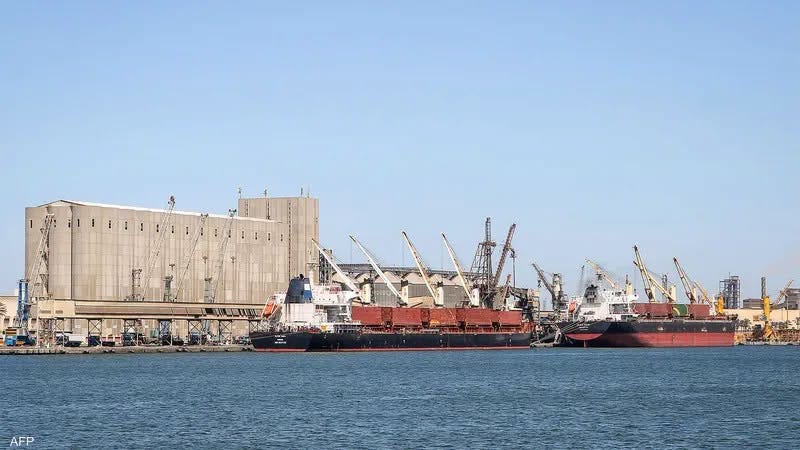
On the evening of Wednesday, July 29, fire broke out aboard a floating LNG storage and regasification unit called the Energos Winter inside the port of Damietta, then spread to the gas carrier GasLog Salem moored beside it. No casualties were announced, the blaze was put out quickly, and the Cabinet later confirmed the cause was a drone. As of this writing, no one has claimed the attack.
The kind of story that could slide past on the news ticker as just another port accident. But let’s ask the question the news ticker never asks: what actually burned in Damietta?
What really burned was an assumption the Egyptian state has been living on for years: we’re far from the war because we’re not in it.
The stricken unit is American in ownership, Egyptian in function. Cairo sees it as a piece of its national energy security; the attacker is free to define it however he pleases: as an American asset.
Which brings us to the question of this piece: how did the electricity of more than a hundred million people become something you can threaten with a tool that costs less than a used car?
The answer comes in three parts: the infrastructure that made the target this valuable, the economics that make a cheap strike profitable, and the agencies on whose watch the drone reached its target unnoticed.
Before those three parts, though, notice that Damietta is one link in a recurring pattern. In September 2019, cheap drones and missiles knocked out half of Saudi Arabia’s oil production at Abqaiq and Khurais for days, and Saudi Arabia is one of the biggest military spenders on earth. In the Red Sea, the U.S. Navy has fired more than two hundred interceptor missiles since late 2023, at a cost approaching a billion dollars, to fend off Houthi drones and missiles tens of times cheaper; its own command has officially called the equation unsustainable.
And in Ukraine, the power grid itself became a front line. Modern wars gravitate toward energy, ports, and cables, because knocking out a single economic function produces a political and social shock greater than any conventional military strike.
How did the target become this valuable?
The story of the floating unit at Damietta is one chapter of a bigger story. A few years ago Egypt was celebrating gas self-sufficiency and planning its role as a regional energy hub. Then output at the Zohr field fell by about 30 percent between 2021 and 2024, Egypt flipped into a net gas importer, and its LNG imports hit a record of nearly nine million tons in 2025.
The gateway for all that importing is a handful of floating regasification units moored in the ports. After the incident, the government announced it has four of them, plus a fifth at the port of Aqaba, and more than 425,000 tons of fuel oil stockpiled at power stations.
This operational flexibility has proven itself: no blackouts, no supply crisis. But the design carries its problems within it. The electricity security of an entire country is concentrated in a few floating, exposed assets, moored along the shoreline, their coordinates known to anyone with a navigation chart. Put your eggs in a few baskets, then tie those baskets up at sea, and the next drone strike stops being a question of if and becomes purely a question of when.
The economics of drones
The arithmetic that keeps repeating itself in drone warfare: a drone worth tens of thousands of dollars against a floating unit worth hundreds of millions, and a power system worth billions. But the more dangerous calculation goes beyond the burnt metal. The market doesn’t just register the strike that happened; the market also prices in the strike that might come next.
Higher insurance premiums on every ship entering an Egyptian port. Costlier freight. Extra caution around the Suez Canal and the SUMED pipeline, two corridors that live and die on perceptions and probabilities. The Canal has lost some nine billion dollars over two years of Red Sea turmoil without a single drone ever being fired at the Canal itself.
Who ends up with the bill?
The company raises prices. The state borrows, or adjusts subsidies. The citizen, at the bottom of the chain, has no one left to pass the cost down to. And this incident lands on an economy already running hot with inflation, after years of accumulated price hikes that have eaten through household margins, with a central bank already warning that renewed conflict and supply-chain disruption are rising risks to prices. The drone hits the port, and the echo reaches the electricity bill, the bus fare, and the loaf of bread. That’s what war on infrastructure is: it usually kills no one, and it quietly makes everyone poorer.
The real test
We need to separate two very different kinds of success here. The first is managing the consequences, and there the state passed beyond argument: rapid firefighting, zero casualties, energy alternatives ready to go, give or take some public panic. The second is preventing the breach, and there the verdict is just as clear: the drone reached its target inside an Egyptian port. The distance between those two successes is exactly the space where the unavoidable questions live.
Was the drone even detected? If so, when? Was there any attempt at interception or jamming? Where was it launched from: a nearby vessel hiding in the shipping traffic, from long range, or from the coast itself? Every one of these answers redistributes responsibility among early warning, detection, decision, and defense.
Two caveats are in order before anyone passes judgment. First: the hypothesis of an Iranian or Iran-aligned actor is the one most consistent with the context and the identity of the target, and it is at the same time too weak to become a final accusation. No claim of responsibility, no debris, no published flight path.
Locking in a hypothesis before the evidence is a classic intelligence error, and it may be exactly what the perpetrator is betting on. Second, the response. Not responding may read as weakness that invites a repeat; a military response without solid attribution may hand the perpetrator his real prize, dragging Egypt into a war someone else chose, at a moment he chose too. Which is why deterrence matters more than a public strike: identify the actor, disrupt his networks, respond through intelligence, and harden the targets until the next attempt isn’t worth making.
Four problems in one drone
What all this makes clear is that Damietta exposed four problems intersecting in a single moment: energy concentrated in a few exposed floating assets; national income hanging on corridors sensitive to risk perceptions before any risk materializes; a household economy with nothing left to absorb another shock; and a decision-making machine now required to prove it can see the bad news coming, not just react to it. The drone found all of these problems waiting for it before it ever took off. All it did was put them on public display, and at a bargain price.
Is air defense the answer?
Not on its own. Whoever intercepts a thousand-dollar weapon with a million-dollar missile is losing the economic war even while winning every engagement on technical and military terms; the Red Sea lesson is sitting right in front of us. What’s needed are cheap, drone-specific layers of defense around the ports: short-range radars, optical and thermal sensors, jamming, low-cost interception. Alongside that, dispersing sensitive assets instead of clustering them at a single berth, deeper strategic reserves, and faster progress on domestic production and renewables to shrink the need for the floating gateways in the first place.
Then comes the most important part, and it’s political: what we might call neutrality. Saudi Arabia learned before us what it means to buy the world’s most expensive systems and get blindsided by its cheapest tools; Ukraine learned that survival lies in dispersal, hardening, and cheap interception. Political neutrality alone is no longer a defense, and economic infrastructure is no longer outside the battle.
In the coming weeks, watch three indicators that will decide where this incident sits in history. Does the state publish a technical report that explains where the failure happened, and holds someone accountable for it? Does a second attempt appear, or a flyover near another facility, turning an incident into a pattern? And which way does the insurance curve on Egyptian ports move? The answers to those questions will tell us whether Damietta was a passing incident, or the beginning of a new era for the Egyptian state.
As for the conclusion that deserves to be written on the door of every operations room in this country, it’s this: a strong state is not the state that is never caught by surprise. It’s the state that never lets the same surprise happen twice.